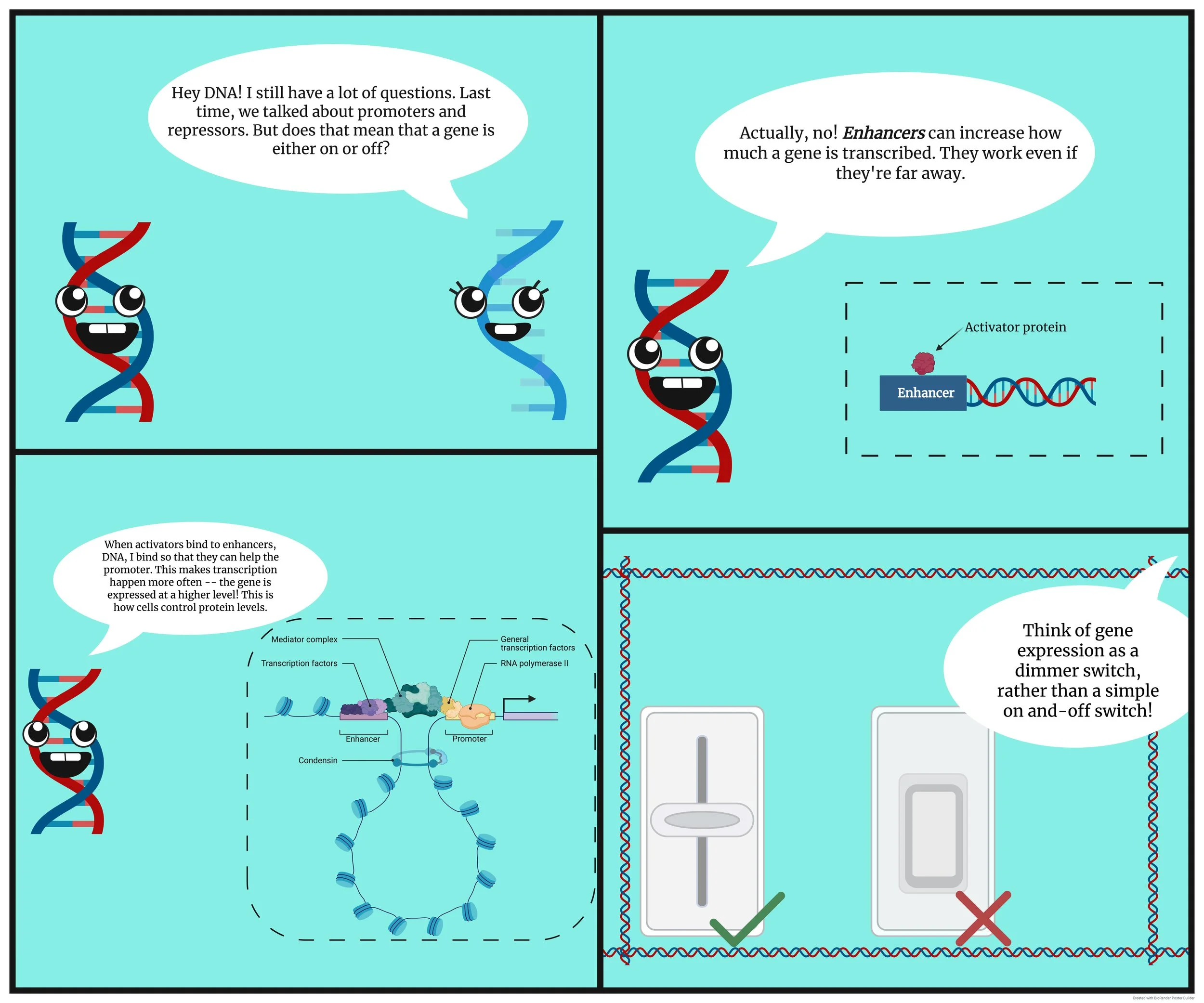
Enhancer - The dimmer switch
Enhancer: the dimmer switch
Think of a gene as a room light. The promoter is the lightbulb’s socket—you can plug the bulb in and, with the right wiring, the light comes on. An enhancer is the dimmer switch somewhere across the room (or the attic), wirelessly tweaking how bright that bulb shines. It doesn’t have to sit next to the gene it controls; it loops over, sends a signal, and tunes expression up or down.
What enhancers do
Boost transcription: They increase the rate at which RNA polymerase starts transcribing a gene, often by recruiting transcription factors and co-activators.
Fine-tune timing and level: Different enhancers can be active at different developmental stages, tissues, or environmental conditions, giving precise control—like presets on a theater lighting board.
Combine inputs: Multiple enhancers can act together (additively, synergistically, or redundantly), integrating signals from distinct transcription factors to produce a specific expression pattern.
Work at a distance: Enhancers can be thousands of base pairs away, upstream, downstream, or even inside introns of other genes, yet still affect their target via DNA looping.
How they work (in plain doodles)
Transcription factors (TFs) bind short DNA motifs in the enhancer.
Bound TFs recruit co-activators (p300/CBP, Mediator) that modify chromatin or bridge to the promoter.
Chromatin remodelers and histone modifiers make the local DNA more accessible (e.g., H3K27ac marks an active enhancer).
The DNA physically loops so the enhancer complex contacts the promoter and stimulates assembly or release of RNA polymerase II, increasing transcription.
Types and flavors
Active enhancers: marked by open chromatin and specific histone modifications (H3K27ac).
Poised enhancers: accessible but not actively driving expression—ready to flip on.
Super-enhancers: clusters of enhancers that together drive very high expression of genes important for cell identity (like the mega-dimmers for cell-fate genes).
Silencers (the opposite): elements that repress nearby genes—think of them as the “off” button.
Why they matter
Development: Enhancers shape when and where genes are expressed—essential for building tissues and organs.
Evolution: Changes in enhancer sequences are a major source of phenotypic diversity; tweaking an enhancer is often safer than